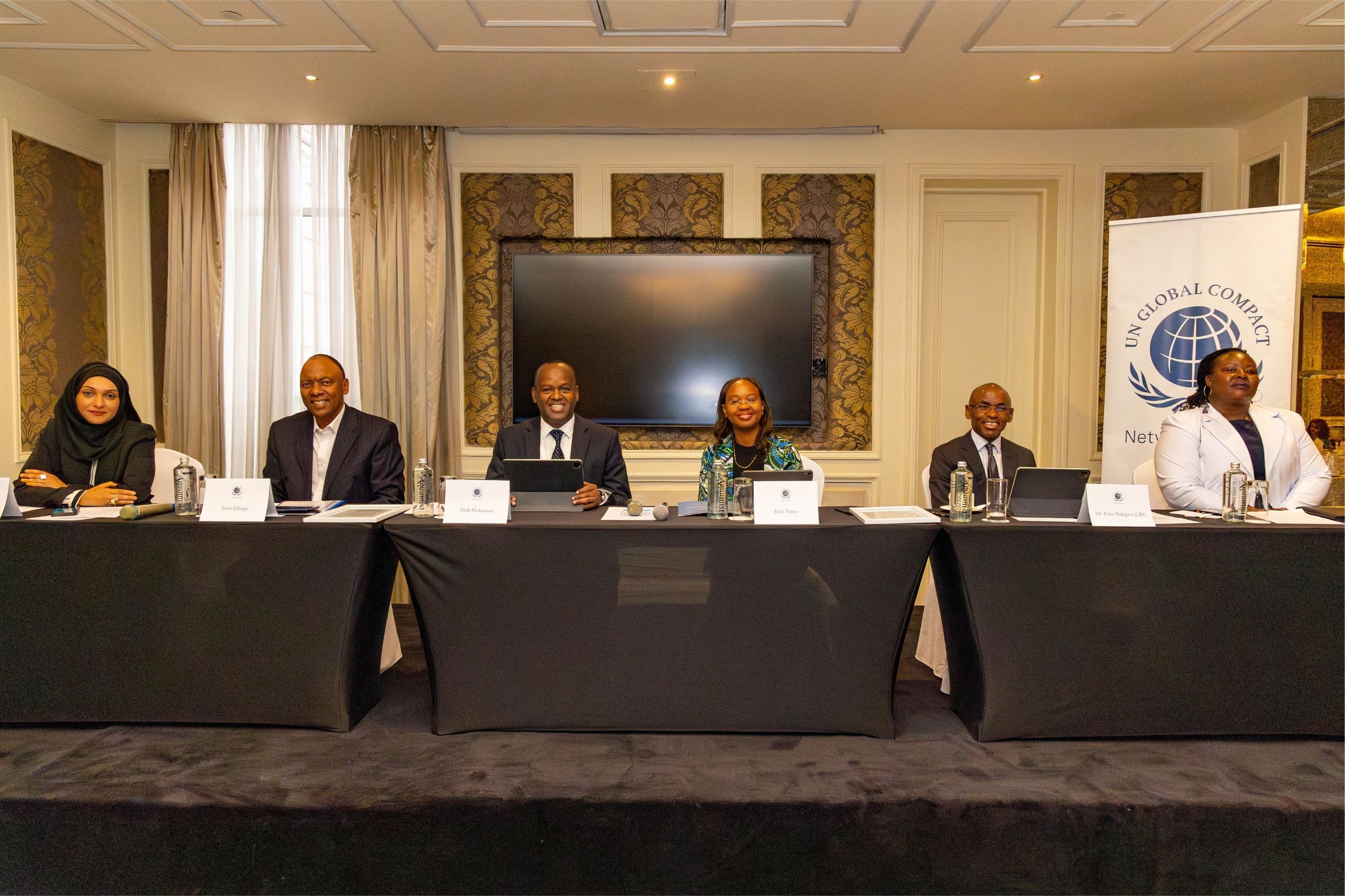
Every year, Global Compact Network Kenya's Annual General Meeting offers more than a date on the calendar. It is a report card moment, a space where participants, Board and partners sit in the same room and ask an honest question: how far has responsible business really moved in Kenya's private sector, and where does the work still need to go.
Our 12th AGM took place today, 23 July 2026, in Nairobi, and that sense of shared accountability was easy to feel in the room.
Sustainability as the price of admission
Opening the Assembly, Board Chair Abdi Mohamed set the tone. In Kenya's evolving business landscape, he said, sustainability is no longer simply a cost of doing business. It is fast becoming the price of admission. Resilience and responsible conduct, he reminded participants, are not opposites of profitability. They are the foundation on which durable, trusted enterprises are built, companies that choose long term value over short term convenience.
That framing landed because it matched what many participants actually lived through in 2025. Currency pressure, thinner margins, a global economy that kept shifting under everyone's feet. In moments like that, sustainability can start to feel like a nice to have. Yet the evidence from across sectors, banking, manufacturing, agriculture, technology, tells a different story. The participants who held the line on governance, human rights, labour, environmental and anti corruption practice were also the ones best placed to absorb the shocks, keep the trust of their stakeholders, and stay competitive.
That link between resilience and responsibility is, in many ways, the whole reason Global Compact Network Kenya exists.
A Board more present in the numbers, and in the room
One of the subtle but more telling data points shared at the AGM was this: a growing share of participating companies now report formal board level oversight of sustainability, a signal that this agenda has moved from the sustainability office into the boardroom itself.
That shift showed up in the room too. Chair Abdi Mohamed was joined at the AGM by Global Compact Network Kenya Board Members, Dr. Peter Ndegwa C.B.S, CEO of SAFARICOM PLC, Sheila Masinde, Executive Director of Transparency International Kenya, Tom Gitogo, Group Managing Director and CEO of Britam, and Dr Toseef Din Msc,FCCA, CPA(K),Bsc, CEO of M.P. Shah Hospital, each bringing a different lens to the conversation on where the Network is heading.
What struck those listening to the exchange was how little of it felt ceremonial. The questions were real, the affirmations specific, the guidance forward looking rather than procedural. That is what governance is supposed to look like: the Board setting direction, keeping an eye on the integrity of the Communications on Progress work, and backing the Secretariat as it turns the Ten Principles into something companies can actually act on, day to day.
Kenya's place in a bigger story
In her presentation, Executive Director Judy Njino walked participants through where the Network has come from, and where it is trying to go next.
Global Compact Network Kenya was launched in 2005 as the Country Network of the United Nations Global Compact. Its mandate, in plain terms, is to help accelerate the collective impact of business in Kenya by embedding the Ten Principles of the UN Global Compact on human rights, labour, environment and anti corruption, and by supporting companies to deliver against the Sustainable Development Goals through accountable practice and stronger ecosystems.
Today, Global Compact Network Kenya is the largest Country Network in Africa and the Middle East, with hundreds of companies and organizations engaged across sectors, from large listed firms to SMEs and non business participants. That scale is not the point in itself. It is the platform. With Kenya carrying a significant share of the continent's UN Global Compact participation, the Network has become something closer to a convener, a place where peer learning, policy dialogue and collective action can happen at a regional level, not just a national one.
Judy tied that trajectory directly to the UN Global Compact's global strategy for 2026 to 2030, which is built around one idea: turning sustainable business ambition into action at the scale the moment demands. For companies here, that means the real work is less about the statement and more about the system. Ethics, human rights, labour standards, climate action, anti corruption, these need to sit inside everyday decisions, not live beside them as a separate initiative.
An engagement model built to meet companies where they are
One theme ran through the Secretariat's presentation more than any other. Impact rarely comes from a single event. It comes from a portfolio of engagement, sustained over time, that meets companies at different stages of the journey.
That portfolio has four parts:
- Connect – brings people into the room through regional and global gatherings, local convenings and practitioner dialogues.
- Learn – runs through online courses, facilitated peer groups and accelerators delivered via the UN Global Compact Academy and local programmes.
- Lead – shows up in policy advocacy, collective action and thematic working groups, where companies help shape the standards they will later be measured against.
- Communicate – is where Communications on Progress support lives, alongside guidance on reporting and space to share what is actually working.
In 2025, that translated into a full calendar of engagement across social sustainability, labour and human rights, gender equality, environment and anti corruption, with executives and sustainability practitioners showing up to workshops, accelerators and working groups, often comparing notes on the same challenges from very different vantage points.
Judy was clear that the AGM itself sits inside this cycle rather than outside it. It is the point in the year where the Network stops, checks whether all that engagement is actually changing behaviour, and resets priorities accordingly.
Communications on Progress as the real report card
If the AGM is a report card, Communications on Progress is where most of the grading happens.
Participants have steadily lifted their CoP submission rates and the quality of what they submit, with more companies now using the digital questionnaire alongside fuller sustainability reports as part of their normal reporting rhythm. The point raised at the AGM was a simple but important one: strong CoP numbers are not about compliance for its own sake. They are what makes it possible to say, with real data, how Kenyan business is putting the Ten Principles into practice.
The same data is also honest about where the gaps sit. Companies often move faster on adopting a policy than on building the systems to monitor or enforce it, particularly once you look past their own operations and into their supply chains. Environmental commitments are growing but still show a gap between what is planned and what is actually done. SMEs, in particular, are showing real intent but need support that fits their scale rather than a one size approach built for larger firms.
With that picture in view, the Network set out where it wants to focus in the year ahead. That means reducing delisting by working harder on participant value and outreach, protecting Kenya's strong CoP performance by helping the remaining companies get their submissions in, rebuilding participant numbers while going deeper on engagement rather than just wider, and using Kenya's position as Africa's leading Country Network to pull the rest of the continent into closer collaboration.
None of that is only about compliance. Most of it is about partnership.
Where this leaves us
Put together, the reflections, the data and the discussions from this AGM point somewhere fairly clear.
Kenyan companies are operating in a hard environment, and a good number of them are proving that resilience and responsibility can move in the same direction rather than pulling apart. The Board is leaning further into oversight and direction. The Secretariat is sharpening an engagement model built for depth, not just reach. And across the community, there is a growing sense that sustainability is not something bolted onto the business. It is part of how capital gets raised, risk gets managed, people get treated, and communities get served.
Our role, as we see it, is to keep providing the frameworks, the clarity and the partnerships that let participants turn commitment into consistent practice. And to keep showing up, year after year, so that this AGM stays what it is meant to be, an honest accounting, not a formality.
Stay part of the story
If you want to go deeper into the numbers and the stories behind this year's highlights, our 2025 Annual Report is the place to start: HERE
And if your organization is not yet part of this community, or you simply want to understand what participation could look like, reach out to us at info@globalcompactkenya.org.