Kenya’s contribution to the business conversations in New York next week will span financial leadership, healthcare, enterprise development and innovation. Business leaders and young professionals will bring experience to discussions on financing Africa’s growth, sustaining trust and shaping a responsible digital future.
At home, the conversation will continue in Nairobi. On Monday, September 21, Global Compact Network Kenya will convene a GABI Kenya Watch Party on responsible artificial intelligence and digital value creation, connecting local business discussion with Unstoppable Africa 2026 in New York.
Together, these engagements offer a valuable exchange: Kenyan experience informing global ambition, and international dialogue helping businesses here consider what comes next.
For Global Compact Network Kenya, this is a week to celebrate our Participants and the wider Kenyan community, and explore the possibilities for collective action beyond the events.
Understanding the week ahead
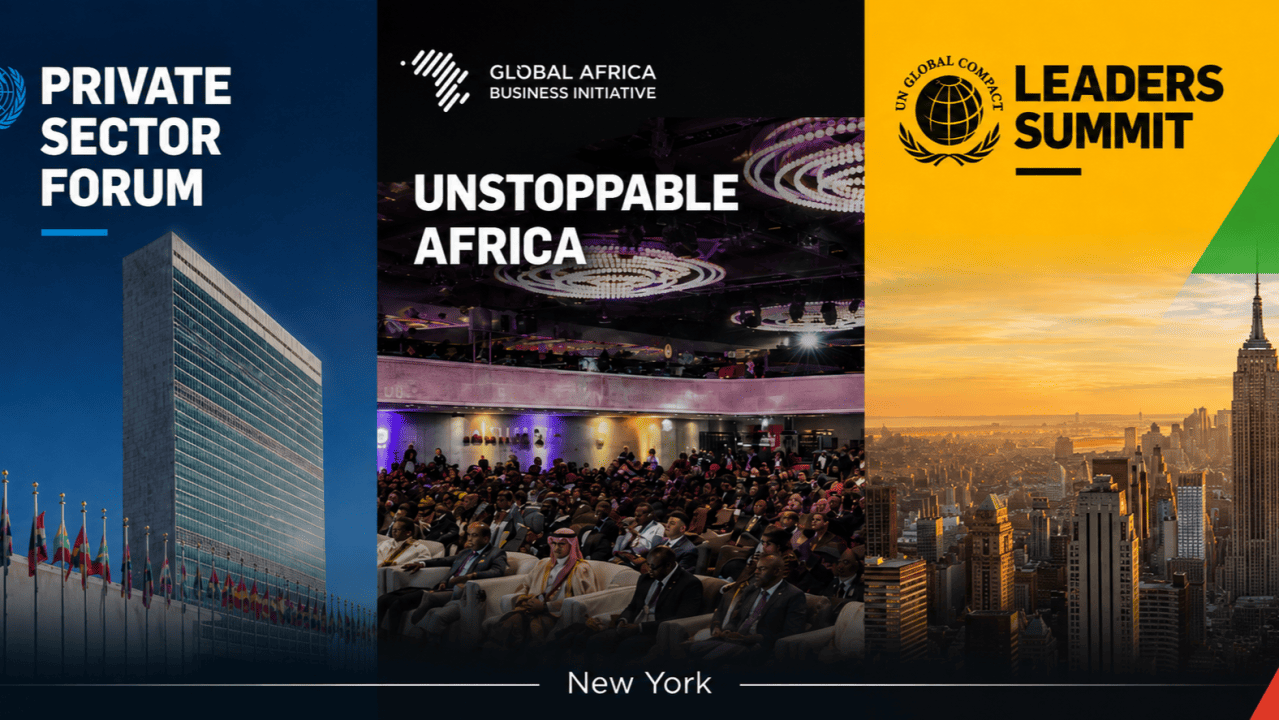
Three major business convenings will take place alongside the 81st Session of the United Nations General Assembly, each with a distinct purpose.
The Global Africa Business Initiative (GABI): Unstoppable Africa 2026 takes place on September 20 and 21 at the New York Marriott Marquis. It brings African and global business leaders together with governments, investors and entrepreneurs around the continent’s economic priorities. Under the theme “Powering Business, Scaling Economies, Shaping the Future,” this year’s gathering emphasizes investment and the conditions that enable African businesses to grow.
On Sunday, September 20, the United Nations Private Sector Forum will convene senior leaders from business, government and the United Nations at United Nations Headquarters. Hosted by the United Nations Global Compact on behalf of the United Nations Secretary-General, the invitation-only forum will focus on accelerating a clean and just energy transition. Its discussions will address the investment, infrastructure and policy conditions needed to expand access and move implementation forward.
The UN Global Compact Leaders Summit follows on September 22 and 23, also at the New York Marriott Marquis. It will examine how companies can make sustainability part of business strategy and implementation, grounded in the Ten Principles of the UN Global Compact and the Sustainable Development Goals (SDGs). Its programme covers leadership and integrity, climate and nature, human rights and decent work, sustainable finance, collective action, and procurement and supply chains.
Other high-level convenings will bring business and public institutions together around specific challenges. Kenyan contributors will bring experience from the markets they operate in and the people they serve.
Financing Africa’s growth and expanding trade
At Unstoppable Africa, Dr. James Mwangi, Group Managing Director and Chief Executive Officer of Equity Bank Limited, will join “Strategic Dialogue: Building the System That Finances Africa at Scale” on September 20. The session examines how African financial institutions mobilize and deploy capital. His contribution brings a banking perspective to the financial systems needed to support enterprise growth across the continent.
Tom Gitogo, Group Managing Director and Chief Executive Officer of Britam, will contribute to the Africa Business Leaders Coalition’s trade discussion on September 21. This will explore the private sector’s role in realizing the opportunities of the African Continental Free Trade Area, including overcoming barriers and strengthening business collaboration.
For Kenyan companies expanding beyond their home market, finance and trade are closely connected. Businesses need capital to grow, manage risk and sustain relationships across borders. These discussions bring those operating realities into the debate on regional growth.
Leadership and partnerships that support implementation
At the Leaders Summit opening plenary on September 22, Toseef Din Msc,FCCA, CPA(K),Bsc , Chief Executive Officer of M.P. Shah Hospital, will contribute to “Leadership Under Pressure: Clarity, Trust and Credibility.”
In healthcare, leadership decisions affect patients, staff and the institution’s ability to deliver care. Toseef will bring that context to a discussion about communicating clearly, making responsible decisions and sustaining trust through uncertainty.
Later that day, Paul Russo, Group Chief Executive Officer of KCB Bank Group, and Judy Njino, Executive Director of Global Compact Network Kenya, will participate in “Regional Resilience: Financing Sustainability Goals Through Cross-Sector Partnerships.”
The session will consider how business, finance and public institutions can close funding gaps across Africa and other emerging regions. Their roles bring complementary perspectives: mobilizing capital and assessing investment opportunities, and connecting companies around responsible business and shared sustainability priorities.
Companies need suitable financing, while financial institutions need confidence in the projects they support. Public institutions shape the conditions in which both operate. The discussion will explore how partnerships can help these interests align.
Contributing to the green transition
On Day 2 of the Leaders Summit, September 23, Chris Diaz EBS FCIM, Independent Non-Executive Director, Kenya Airways , will contribute to the closed-door “Fueling the Green Transition” roundtable at the New York Marriott Marquis.
His participation adds a further Kenyan business voice to the week’s green transition discussions. It also connects with the wider questions of leadership and implementation running through the programme: how companies prepare for change and translate sustainability priorities into business decisions.
Opening opportunities for smaller businesses
The week’s procurement and supply chain discussions have particular relevance for Kenya’s micro, small and medium enterprises.
On September 21, Hon. Susan Mang'eni, Principal Secretary, State Department for Micro, Small and Medium Enterprises Development, will contribute to the High-Level Forum on Sustainable Procurement at UN Headquarters in New York. Her participation brings an enterprise development perspective to the conversation about purchasing decisions and sustainable business opportunity.
At the Leaders Summit on September 23, Yusuf Omari , Chief Executive Officer and Managing Director of Absa Bank Kenya, will participate in “Spark: Transforming Supply Chain Pressure into Growth and Opportunity.” The discussion will consider how small and medium-sized enterprises can respond to buyer requirements, regulations and market expectations through practical sustainability plans and financing strategies.
For a smaller supplier, meeting new requirements may involve investing in systems, skills or equipment before additional business follows. Procurement ambition needs to be matched by support that enables enterprises to participate. These Kenyan contributions help keep that relationship in view.
Safaricom PLC will also contribute to the Leaders Summit’s discussions on inclusion and ethical business. Karen Basiye will join “Gender Equality at Scale: Business Leadership for Enabling Environments,” examining how business can help address structural barriers through collective action. Sally Mwenesi, Principal, Fraud Prevention and Ethics, will contribute to “Integrity as a Competitive Advantage,” bringing experience in corporate integrity and responsible business practice.
A Kenyan innovation earns a global platform
We will also be following I&M Bank Ltd’s TekeTeke innovation, which explores how gig economy workers can access working capital.
Developed through the SDG Innovation Accelerator for Young Professionals, the project progressed through the national process coordinated by Global Compact Network Kenya. From a global pool of 21 companies representing their national cohorts, I&M Bank was selected as one of five teams to present at the Leaders Summit, alongside teams from Nigeria, Ghana, the United Kingdom and China. Lucian Ouma and Albert Lumumba will represent the team in New York.
TekeTeke focuses on a recognizable challenge: workers may have income-generating opportunities but struggle to obtain flexible financing to pursue them. The project explores how banking can respond to those needs and help workers manage cash flow and strengthen their livelihoods.
Through mentorship and structured development, the UN Global Compact accelerator helps young professionals address sustainability challenges within their companies. I&M Bank’s selection shows how an idea grounded in a local problem can earn an international audience, and invites other Participants to consider the ideas within their own teams.
Bringing the digital conversation to Nairobi
On Monday, September 21, the GABI Kenya Watch Party will bring the week’s digital transformation discussion into a local setting under the theme “Responsible AI and Digital Value Creation.”
Global Compact Network Kenya’s planned programme combines a Kenya-based panel, selected Unstoppable Africa highlights and live viewing of “Panel of the Future: Building Digital Africa’s Value Change-Makers,” followed by a moderated reflection on implications for Kenyan business. Ambassador Philip Thigo, MBS , Kenya’s Special Envoy on Technology, is set as the moderator of the New York session, creating a direct Kenyan connection to the discussion Nairobi will follow.
The local dialogue will examine how Kenyan businesses can build and own digital solutions responsibly. It will consider who benefits from the value created, how personal data is protected, and the skills people need to participate.
A company introducing AI into recruitment, lending or service delivery must consider its effects on people, the reliability of its systems and who is accountable when something goes wrong. The watch party will examine these responsibilities through Kenyan business experience.
Participants will consider the New York discussion against local priorities, build connections across sectors and identify opportunities for further collaboration on responsible AI.
Carrying the conversations forward
Kenya’s contributions will connect business leadership with the work of practitioners, innovators and public institutions. That breadth of participation gives us much to celebrate and learn from.
The opportunity for collective action continues after the sessions end. Finance discussions can lead to new partnerships; procurement insights can inform support for smaller enterprises. An innovation presentation may encourage another employer to back an idea within its own team.
As Global Compact Network Kenya, we look forward to supporting these connections and sharing perspectives and highlights from New York and Nairobi. We invite our Participants and partners to follow the week’s conversations, engage with the ideas emerging, and consider where we can work together to advance responsible business in Kenya.